Prof. Thomas Ouldridge
Department of Bioengineering, Imperial College London, UK
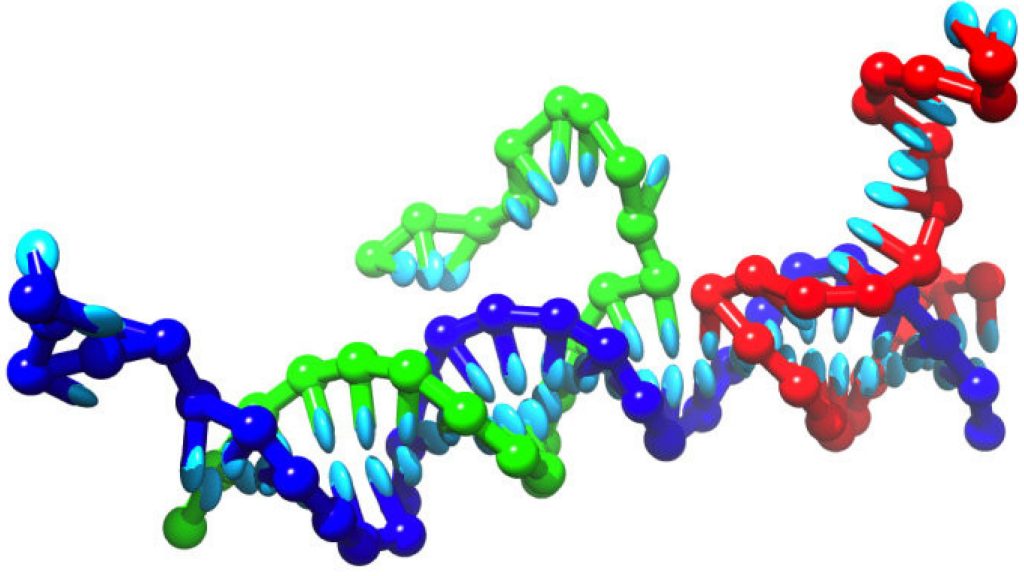
The student will develop predictive models of nucleic acid strand displacement rates to allow the rational design of complex networks of ever-increasing functionality. State of the art models mainly focus on highly-idealised systems that involve only carefully designed DNA strands at low concentrations in well-mixed solutions. In this project, the student will study strand displacement technology in more complex, hybrid environments to demonstrate predictive models that can account for these more complex settings. Using molecular-level simulations, basic theory and experimental data, the student will develop predictive models of strand displacement reactions in non-ideal settings, in collaboration with the other students within BIOHYBRITE. These areas include: structured environments, such as the synthetic cells; environments with competing interaction partners; and systems with hybrid RNA-DNA duplexes.
Requirements:
Degree in a subject related to physical, chemical, biological or computational science, and an interest in theoretical modelling.
Planned secondments: Simmel lab, Keyser lab, Di Michele lab
Salary: Annual gross salary min €59,783.49 – max € 65,875.80 (+ €660.00 family allowance, if applicable).
The salary (36 months) is directly based on Marie Sklodowska-Curie Actions (MSCA) Doctoral Network budgeting (including a country-specific living allowance and a fixed mobility allowance for a doctoral candidate, as well as a possible family allowance).